Pakistan ( i/ˈpækɨstæn/ or i/pɑːkiˈstɑːn/; Urdu: پاكستان ALA-LC: Pākistān, pronounced [pɑːkɪst̪ɑːn] (
 listen)), officially the Islamic Republic of Pakistan (Urdu: اسلامی جمہوریۂ پاكستان ALA-LC: Islāmī Jumhūriyah-yi Pākistān IPA: [ɪslɑːmiː d͡ʒʊmɦuːriəɪh pɑːkɪst̪ɑːn]), is asovereign country in South Asia. With a population exceeding 180 million people, it is the sixth most populous country and with an area covering 796,095 km2 (307,374 sq mi), it is the 36th largest country in the world in terms of area. Pakistan has a 1,046-kilometre (650 mi) coastline along the Arabian Sea and the Gulf of Oman in the south and is bordered by the countries India to the east, Afghanistan to the west, Iran to the southwest and China in the far northeast respectively. It is separated from Tajikistan by Afghanistan's narrow Wakhan Corridor in the north, and also shares a marine border with Oman.
i/ˈpækɨstæn/ or i/pɑːkiˈstɑːn/; Urdu: پاكستان ALA-LC: Pākistān, pronounced [pɑːkɪst̪ɑːn] ( listen)), officially the Islamic Republic of Pakistan (Urdu: اسلامی جمہوریۂ پاكستان ALA-LC: Islāmī Jumhūriyah-yi Pākistān IPA: [ɪslɑːmiː d͡ʒʊmɦuːriəɪh pɑːkɪst̪ɑːn]), is asovereign country in South Asia. With a population exceeding 180 million people, it is the sixth most populous country and with an area covering 796,095 km2 (307,374 sq mi), it is the 36th largest country in the world in terms of area. Pakistan has a 1,046-kilometre (650 mi) coastline along the Arabian Sea and the Gulf of Oman in the south and is bordered by the countries India to the east, Afghanistan to the west, Iran to the southwest and China in the far northeast respectively. It is separated from Tajikistan by Afghanistan's narrow Wakhan Corridor in the north, and also shares a marine border with Oman.
The territory that now constitutes Pakistan was previously home to several ancient cultures, including the Mehrgarh of the Neolithicand the Bronze Age Indus Valley Civilisation, and was later home to kingdoms ruled by people of different faiths and cultures, including Hindus, Indo-Greeks, Muslims, Turco-Mongols, Afghans and Sikhs. The area has been ruled by numerous empires and dynasties, including the Indian Mauryan Empire, the Persian Achaemenid Empire, Alexander of Macedonia, the Arab Umayyad Caliphate, the Mongol Empire, the Mughal Empire, the Durrani Empire, the Sikh Empire and the British Empire. As a result of thePakistan Movement led by Muhammad Ali Jinnah and the subcontinent's struggle for independence, Pakistan was created in 1947 as an independent nation for Muslims from the regions in the east and west of Subcontinent where there was a Muslim majority. Initially a dominion, Pakistan adopted a new constitution in 1956, becoming an Islamic republic. A civil war in 1971 resulted in the secession of East Pakistan as the new country of Bangladesh.
Pakistan is a federal parliamentary republic consisting of four provinces and four federal territories. It is an ethnically and linguisticallydiverse country, with a similar variation in its geography and wildlife. A regional and middle power,[13][14] Pakistan has the seventh largest standing armed forces in the world and is also a nuclear power as well as a declared nuclear-weapons state, being the only nation in the Muslim world, and the second in South Asia, to have that status. It has a semi-industrialised economy with a well-integrated agriculture sector, its economy is the 26th largest in the world in terms of purchasing power and 45th largest in terms of nominal GDP and is also characterized among the emerging and growth-leading economies of the world.
The post-independence history of Pakistan has been characterised by periods of military rule, political instability and conflicts with neighbouring India. The country continues to face challenging problems, including overpopulation, terrorism, poverty, illiteracy, andcorruption. Despite these factors it ranked 16th on the 2012 Happy Planet Index.[15] It is a member of the United Nations, theCommonwealth of Nations, the Next Eleven Economies, ECO, UfC, D8, Cairns Group, Kyoto Protocol, ICCPR, RCD, UNCHR, Asian Infrastructure Investment Bank, Group of Eleven, CPFTA, Group of 24, the G20 developing nations, ECOSOC, founding member of the Organisation of Islamic Cooperation, SAARC and CERN.[16]
Contents
[hide]Etymology
The name Pakistan literally means "Land of the Pure" in Urdu and Persian. It comes from the word pāk meaning pure in Persian andPashto[17] while the word istān is a Persian word meaning place of; it is a cognate of the Sanskrit word sthān (Devanagari: स्थान[st̪ʰaːn]).[18]
It was coined in 1933 as Pakstan by Choudhry Rahmat Ali, a Pakistan Movement activist, who published it in his pamphlet Now or Never,[19] using it as an acronym ("thirty million Muslim brethren who live in PAKSTAN") referring to the names of the five northern regions of the British Raj: Punjab, Afghania, Kashmir, Sindh, and Baluchistan".[20][21][22] The letter i was incorporated to ease pronunciation and form the linguistically correct and meaningful name.[23]
History
Main articles: History of Pakistan and History of South Asia

Early and medieval age
Main articles: Indo-Greek Kingdom, Indus Valley Civilization, Vedic Civilization, Sikh Empire and Mughal Empire

Some of the earliest ancient human civilisations in South Asia originated from areas encompassing present-day Pakistan.[24] The earliest known inhabitants in the region were Soanian during the Lower Paleolithic, of whom stone tools have been found in the Soan Valley of Punjab.[25] The Indus region, which covers most of Pakistan, was the site of several successive ancient cultures including the Neolithic Mehrgarh[26] and the Bronze Age Indus Valley Civilisation (2800–1800 BCE) at Harappa and Mohenjo-Daro.[27][28]
The Vedic Civilization (1500–500 BCE), characterised by Indo-Aryan culture, laid the foundations of Hinduism, which would become well established in the region.[29][30] Multan was an important Hindu pilgrimage centre.[31] The Vedic civilisation flourished in the ancient Gandhāran city of Takṣaśilā, now Taxila in Punjab.[26] Successive ancient empires and kingdoms ruled the region: the Persian Achaemenid Empire around 519 BCE, Alexander the Great's empire in 326 BCE[32] and the Maurya Empire founded by Chandragupta Maurya and extended by Ashoka the Great until 185 BCE.[26]The Indo-Greek Kingdom founded by Demetrius of Bactria (180–165 BCE) included Gandhara and Punjab and reached its greatest extent underMenander (165–150 BCE), prospering the Greco-Buddhist culture in the region.[26][33] Taxila had one of the earliest universities and centres of higher education in the world.[34][35][36][37]
The Medieval period (642–1219 CE) is defined by the spread of Islam in the region. During this period, Sufi missionaries played a pivotal role in converting a majority of the regional Buddhist and Hindu population to Islam.[38] The Rai Dynasty (489–632 CE) of Sindh, at its zenith, ruled this region and the surrounding territories.[39] The Pala Dynasty was the last Buddhist empire that under Dharampala and Devapala stretched acrossSouth Asia from what is now Bangladesh through Northern India to Pakistan and later to Kamboj region in Afghanistan.
The Arab conqueror Muhammad bin Qasim conquered Indus valley from Sindh to Multan in southern Punjab in 711 CE.[40][41][42][43] The Pakistan government's official chronology identifies this as the point where the "foundation" of Pakistan was laid.[40][44][45] This conquest set the stage for therule of several successive Muslim empires in the region, including the Ghaznavid Empire (975–1187 CE), the Ghorid Kingdom and the Delhi Sultanate (1206–1526 CE). The Lodi dynasty, the last of the Delhi Sultanate, was replaced by the Mughal Empire (1526–1857 CE). The Mughals introduced Persian literature and high culture, establishing the roots of Indo-Persian culture in the region.[46] In the early 16th century, the region remained under the Mughal Empire ruled by Muslim emperors.[47] By the early 18th century, the increasing European influence caused to slowly disintegrate the empire with the lines between commercial and political dominance being increasingly blurred.[47]

During this time, the English East India Company, had established coastal outposts.[47] Control over the seas, greater resources, technology, and military force projection by East India Company of British Empire led it to increasingly flex its military muscle; a factor that was crucial in allowing the Company to gain control over subcontinent by 1765 and sidelining the European competitors.[48] Expanding access beyond Bengal and the subsequent increased strength and size of its army enabled it to annex or subdue most of region by the 1820s.[47] To many historians, this marked the starting of region's colonial period.[47] By this time, with its economic power severely curtailed by the British parliament and itself effectively made an arm of British administration, the Company began to more consciously enter non-economic arenas such as education, social reform, and culture.[47] Such reforms included the enforcement of English Education Act in 1835 and the introduction of the Indian Civil Service (ICS).[49] Tradition Madrasahs– a primary institutions of higher learning forMuslims in subcontinent– were no longer supported by the English Crown, and nearly all of the Madrasahs lost their financial endowment.[50]
Colonial period


The gradual decline of the Mughal Empire in the early 18th century enabled Sikh Empire's influence to control larger areas until the British East-India Company gained ascendancy over the Indian subcontinent.[51] The rebellion in 1857 (or Sepoy mutiny) was the region's major armed and serious struggle against the British Empire and Queen Victoria.[52] Divergence in the relationship between Hinduism and Islam created a major rift in British India; thus instigating racially-motivated religious violence in India.[53] The language controversy further escalated the tensions between Hindus and Muslims.[54] The Hindu renaissance witnessed the awakening of intellectualism in traditional Hinduism and saw the emergence of more assertive influence in social and political sphere in British India.[55][56] Intellectual movement to counter the Hindu renaissance was led by Sir Syed Ahmad Khan who help founded the All-India Muslim League in 1901 and envisioned as well as advocated for theTwo-nation theory.[51] In contrast to Indian Congress's anti-British efforts, the Muslim League was a pro-British whose political program inherited the British values that would shape the Pakistan's future civil society.[57][58] In the events during the World War I, the British Intelligence foiled an anti-English conspiracy involving the nexus of Congress and the German Empire.[59]The largely non-violent independence struggle led by the Indian Congress engaged millions of protesters in mass campaigns of civil disobedience in the 1920s and 1930s against the British Empire.[60][61][62]

The Muslim League slowly rose to mass popularity in the 1930s amid fears of under-representation and neglect of Muslims in politics. In his presidential address of 29 December 1930, Allama Iqbal called for "the amalgamation ofNorth-West Muslim-majority Indian states" consisting of Punjab, North-West Frontier Province, Sind and Baluchistan.[64] Muhammad Ali Jinnah, the founder of Pakistan, greatly espoused the two-nation theory and led the Muslim League to adopt the Lahore Resolution of 1940, popularly known as the Pakistan Resolution.[51] Events leading to the World War II, Jinnah and British educatedfounding fathers in the Muslim League supported the United Kingdom's war efforts, countering opposition against it whilst worked towards Sir Syed's vision.[65]
As cabinet mission failed in India, the Great Britain announced the intentions to end its raj in India in 1946–47.[66] Nationalists inBritish India– including Jawaharlal Nehru and Abul Kalam Azad of Congress, Jinnah of Muslim League, and Master Tara Singhrepresenting the Sikhs—agreed to the proposed terms of transfer of power and independence in June 1947.[67] As the United Kingdom agreed upon partitioning of India in 1947, the modern state of Pakistan was established on 14 August 1947 (27th of Ramadanin 1366 of the Islamic Calendar) in amalgamating the Muslim-majority eastern and northwestern regions of British India.[62] It comprised the provinces of Balochistan, East Bengal, the North-West Frontier Province, West Punjab and Sindh; thus forming Pakistan.[51][67]The partitioning of Punjab and Bengal led to the series of violent communal riots across India and Pakistan; millions of Muslims moved to Pakistan and millions of Hindus and Sikhs moved to India.[68] Dispute over Jammu and Kashmir led to the First Kashmir War in 1948.[69][70]
Independence and modern Pakistan
After independence from the partition of India in 1947, Muhammad Ali Jinnah, the President of Muslim League, became nation's firstGovernor-General as well as first President-Speaker of the Parliament.[71] Meanwhile, Pakistan's founding fathers agreed upon appointingLiaquat Ali Khan, the secretary-general of the party, nation's first Prime Minister. A dominion status in the Commonwealth of Nations, Pakistan was under two British monarch when George VI relinquished the title of Emperor of India to become King of Pakistan in 1947.[71]After George VI's death on 6 February 1952, Elizabeth II became the Queen of Pakistan who retained the title until Pakistan becoming theIslamic republic in 1956,[72] but democracy was stalled by the martial law enforced by President Iskander Mirza who was replaced by army chief, General Ayub Khan. Forming presidential system in 1962, the country experienced exceptional growth until a second war with Indiain 1965 which led to economic downfall and wide-scale public disapproval in 1967.[73][74] Consolidating the control from Ayub Khan in 1969, President Yahya Khan had to deal with a devastating cyclone which caused 500,000 deaths in East Pakistan.[75]

In 1970, Pakistan held its first democratic elections since independence, that were meant to mark a transition from military rule to democracy, but after the East Pakistani Awami League won against Pakistan Peoples Party (PPP); Yahya Khan and military establishment refused to hand over power.[76][77] Instigatedcivil unrest invited the military launched an operation on 25 March 1971, aiming to regain control of the province.[76][77] The genocide carried out during this operation led to a declaration of independence and to the waging of a war of liberation by the Bengali Mukti Bahini forces in East Pakistan, with support from India.[77][78] However, in West Pakistan the conflict was described as a civil war as opposed to War of Liberation.[79]
Independent estimates of civilian deaths during this period range from 300,000 to 3 million.[80] Preemptive strikes on India by the Pakistan's air force, navy, and marines sparked the conventional war in 1971, which witnessed the Indian victory and East Pakistan gaining independence asBangladesh.[77]
With Pakistan surrendering in the war, Yahya Khan was replaced by Zulfikar Ali Bhutto as President; the country worked towards promulgatingconstitution and putting the country on roads of democracy. Democratic rule resumed from 1972 to 1977– an era of self-consciousness, intellectual leftism, nationalism, and nationwide reconstruction.[81] During this period, Pakistan embarked on ambitiously developing the nuclear deterrence in 1972 in a view to prevent any foreign invasion; the country's first nuclear power plant was inaugurated, also the same year.[82][83]Accelerated in response to first nuclear test by India in 1974, this crash program completed in 1979.[83] Democracy ended with a military coup in 1977 against the leftist PPP, which saw General Zia-ul-Haq becoming the president in 1978. From 1977–88, President Zia's corporatisation andeconomic Islamisation initiatives led to Pakistan becoming one of the fastest-growing economies in South Asia.[84] While consolidating the nuclear development, increasing Islamization,[85] and the rise homegrown conservative philosophy, Pakistan helped subsidize and distribute U.S.resources to factions of the mujahideen against the USSR's intervention in communist Afghanistan.[86][87]
President Zia died in a plane crash in 1988, and Benazir Bhutto, daughter of Zulfikar Ali Bhutto, was elected as country's first female Prime Minister. The Pakistan Peoples Partyfollowed by conservative Pakistan Muslim League (N), and over the next decade whose two leaders fought for power, alternating in office while the country's situation worsened; economic indicators fell sharply, in contrast to the 1980s. This period is marked by prolonged stagflation, instability, corruption, nationalism, geopolitical rivalry with India, and the clash of left wing-right wing ideologies.[88][89] As PML(N) securing supermajority in elections in 1997, Sharif authorised the nuclear testings (See:Chagai-I and Chagai-II), as aretaliation to second nuclear tests ordered by India, led by Prime Minister Atal Bihari Vajpayee in May 1998.[90]

Military tension between the two countries in the Kargil district led to the Kargil War of 1999, and a turbulence in civic-military relationsallowed General Pervez Musharraf took over through a bloodless coup d'état.[91][92] Musharraf governed Pakistan as chief executive from 1999 to 2001 and as President from 2001 to 2008— a period of enlightenment, social liberalism, extensive economic reforms,[93] anddirect involvement in the U.S.-led war on terrorism. When the National Assembly historically completed its first full five-year term on 15 November 2007, the new elections were called by Election Commission.[94] After the assassination of Benazir Bhutto in 2007, the PPPsecured largest votes in the elections of 2008, appointing party member Yousaf Raza Gillani as Prime Minister.[95] Threatened to faceimpeachment, President Musharraf resigned on 18 August 2008, and was succeeded by Asif Ali Zardari.[96][97][98] Clashes with thejudicature prompted Gillani's disqualification from the Parliament and as the Prime Minister in June 2012.[99] By its own financial calculations, Pakistan's involvement in the war on terrorism has cost up to ~$67.93 billion,[100][101] thousands of casualties and nearly 3 million displaced civilians.[102] The general election held in 2013 saw the PML(N) achieved almost supermajority, following which Nawaz Sharif became elected as the Prime Minister, returning to the post for the third time after fourteen years, in a democratic transition.[103]
Government and politics
Main articles: Government of Pakistan, Politics of Pakistan, Political history of Pakistan and Human rights in Pakistan
Pakistan is a democratic parliamentary federal republic with Islam as the state religion.[104] The first set was adopted in 1956 but suspended by Ayub Khan in 1958 who replaced it with second set in 1962.[62] Complete and comprehensive Constitution was adopted in 1973—suspended by Zia-ul-Haq in 1977 but reinstated in 1985—is the country's most important document, laying the foundations of the current government.[105] The Pakistani military establishment has played an influential role in mainstream politics throughoutPakistan's political history.[62] Presidents are brought in by military coups who imposed in martial law in 1958–1971, 1977–1988, and 1999–2008.[106] As of current, Pakistan has a multi-party parliamentary system with clear division of powers and responsibilities between branches of government. The first successful demonstrative transaction was held in May 2013. Politics in Pakistan is centered and dominated by the homegrown conceive social philosophy, consisting the ideas of socialism, conservatism, and the third way. As ofgeneral elections held in 2013, the three main dominated political parties in the country: the centre-right conservative Pakistan Muslim League-N (PML-N); the centre-left socialistPakistan Peoples Party (PPP); and the centrist and third-way Pakistan Movement for Justice (PTI) led by cricketer Imran Khan.
- Head of State: The President who is elected by an Electoral College is the ceremonial head of the state and is the civilian commander-in-chief of the Pakistan Armed Forces(with Chairman Joint Chiefs of Staff Committee as its principal military adviser), but military appointments and key confirmations in the armed forces are made by the Prime Minister after reviewing the reports on their merit and performances. Almost all appointed officers in the judicature, military, chairman joint chiefs and joint staff, and legislatures require the executive confirmation from the Prime Minister, whom the President must consult, by law. However, the powers to pardon and grant clemency vest with the President of Pakistan.
- Legislative: The bicameral legislature comprises a 100-member Senate (upper house) and a 342-member National Assembly (lower house). Members of the National Assembly are elected through the first-past-the-post system under universal adult suffrage, representing electoral districts known as National Assembly constituencies. According to the constitution, the 70 seats reserved for women and religious minorities are allocated to the political parties according to their proportional representation. Senate members are elected by provincial legislators, with all of provinces have equal representation.
- Executive: The Prime Minister is usually the leader of the majority rule party or a coalition in the National Assembly— the lower house. The Prime Minister serves as the head of government and is designated to exercise as the country's chief executive. The Prime Minister is responsible for appointing a cabinet consisting of ministers and advisors as well as running the government operations, taking and authorizing executive decisions, appointments and recommendations that require executive confirmation of the Prime Minister.
- Provincial governments: Each of the four province has a similar system of government, with a directly elected Provincial Assembly in which the leader of the largest party or coalition is elected Chief Minister. Chief Ministers oversees the provincial governments and head the provincial cabinet, it is common in Pakistan to have different ruling parties or coalitions in each provinces. The provincial assemblies have power to make laws and approve provincial budget which is commonly presented by the provincial finance minister every fiscal year. Provincial governors who play role as the ceremonial head of province are appointed by the President.[105]
- Judicature: The judiciary of Pakistan is a hierarchical system with two classes of courts: the superior (or higher) judiciary and the subordinate (or lower) judiciary. The Chief Justice of Pakistan is the chief judge who oversees the judicature's court system at all levels of command. The superior judiciary is composed of the Supreme Court of Pakistan, the Federal Shariat Court and five High Courts, with the Supreme Court at the apex. The Constitution of Pakistan entrusts the superior judiciary with the obligation to preserve, protect and defend the constitution. Neither the Supreme Court nor a High Court may exercise jurisdiction in relation to Tribal Areas, except otherwise provided for. The disputed regions of Azad Kashmir and Gilgit–Baltistan have separate court systems.


Foreign relations of Pakistan
Main article: Foreign relations of Pakistan
.jpg)
A second most populous nation-state (after Indonesia) and being the singular nuclear power state in the Muslim world, enabled the country to play a important role in the international community.[107][108] With semi-agriculture and semi-industrialized economy, it foreign policy interacts with foreign nations and to determine its standard of interactions for its organizations, corporations and individual citizens.[109][110] Its clear geostrategic intentions were explained by Jinnah who described the principles and objectives of Pakistan's foreign policy in a broadcast message:[111] The objectives of foreign policy of Pakistan:
| “ | The foundation of our foreign policy is friendship with all nations across the globe. | ” |
Since then, Pakistan have tried maintaining balance relations with the foreign nations as part of its determined policy.[112][113][114] A non-signatory party of the Treaty on the Nuclear Non-Proliferation, Pakistan is a good and influential member of the IAEA.[115] In recent event, Pakistan has successfully blocked international initiatives to limit fissile material, as justifying that "treaty would target Pakistan specifically."[116] In most of its 20th century history, Pakistan's nuclear deterrence program focused on countering India's nuclear ambitions in the region, and nuclear tests byIndia eventually led Pakistan to reciprocate the event to maintain geopolitical balance as becoming nuclear power.[117] As of current, Pakistan now maintains a policy of credible minimum deterrence, terming its program as vital nuclear deterrence against any foreign aggression.[118][119]

Located in strategic and geopolitical corridor of the world's major maritime oil supply lines, communication fiber optics, Pakistan has proximity to the natural resources of Central Asian countries.[120] Pakistan is an influential and founding member of the Organisation of Islamic Cooperation (OIC) and is a major non-NATO ally of the United States in the war against terrorism— a status achieved in 2004.[121]Pakistan's foreign policy and geostrategy mainly focuses on economy and security against threats to its national identity and territorial integrity, and on the cultivation of close relations with Muslim countries.[122] Briefing on country's foreign policy in 2004, the Pakistani senator reportedly explains: "Pakistan highlights sovereign equality of states, bilateralism, mutuality of interests, and non-interference in each other's domestic affairs as the cardinal features of its foreign policy."[123] Pakistan is an active member of the United Nations and has a Permanent Representative to represent Pakistan's policy in international politics.[124] Recently, Pakistan has previously lobbied for the concept of "Enlightened Moderation" in the Muslim world.[125][126] Pakistan is also a member of Commonwealth of Nations,[127] the South Asian Association for Regional Cooperation (SAARC), the Economic Cooperation Organisation (ECO)[128][129] and the G20 developing nations.[130] Pakistan does not have diplomatic relations with Israel;[131] nonetheless some Israeli citizens have visited the country on a tourist visas.[132] Based on mutual cooperation, the security exchange have taken place between two countries using Turkey as a communication conduit.[133] Despite Pakistan being the only country in the world that has not established a diplomatic relations with Armenia, the Armenian community still resides in Pakistan.[134]

Maintaining cultural, political, social, and economic relations with the Arab world and other countries in Muslim World is vital factor in Pakistan's foreign policy.[136] Pakistan was the first country to have established diplomatic relations with China and relations continues to be warm since China's war with India in 1962.[137] In the 1960s–1980s, Pakistan greatly helped China in reaching out to the world's major countries and helped facilitate U.S. President Nixon's state visit to China.[137] Despite the change of governments in Pakistan, variations in the regional and global situation, China policy in Pakistan continues to be dominant factor at all time.[137] In return, China is Pakistan's largest trading partner and economic cooperation have reached high points, with substantial Chinese investment in Pakistan's infrastructural expansion including the Pakistani deep-water port at Gwadar.[138][139][140] Both countries have signed the Free Trade Agreement in 2000s, and Pakistan continues to serve as China's communication bridge in the Muslim World.[141]
Difficulties in relations and geopolitical rivalry with India, Pakistan maintains close cultural and political relations with Turkey and Iran.[142]Pakistan has a second largest Shia Islam follower, after Iran, and has maintains close cultural, political, economic, and military relations with Iran.[143] Iran was the first country to establish relations with Pakistan, and since then, Iran has occupied influential place in Pakistan's foreign policy.[143] Turkey and Saudi Arabia also maintains respected position in Pakistan's foreign policy, and both countries has been a focal point in Pakistan's foreign policy.[142] The Kashmir conflict remains the major point of rift; three of their four wars were over this territory.[144] Due to ideological differences, Pakistan opposed the Soviet Union in 1950s and during Soviet-Afghan War in the 1980s, Pakistan was one of the closest allies of the United States.[123][145] Relations with Russia has greatly improved since 1999 and cooperation with various sectors have increased between Russia and Pakistan.[146] Pakistan has had "on-and-off" relations with the United States. A close ally of the United States in the Cold war, Pakistan's relation with the United States relations soured in the 1990s when the U.S. imposed sanctions because of Pakistan's secretive nuclear development.[147]
The United States-led war on terrorism led initially to an improvement in the relationship, but it was strained by a divergence of interests and resulting mistrust during the war in Afghanistan and by issues related to terrorism.[148][149][150][151] Since 1948, there has been an ongoing, and at times fluctuating, violent conflict in the southwestern province ofBalochistan between various Baloch separatist groups, who seek greater political autonomy, and the central government of Pakistan.[152]
Administrative divisions
Main articles: Administrative units of Pakistan and Districts of Pakistan
| Administrative Division | Capital | Population | |
|---|---|---|---|
 | Balochistan | Quetta | 7,914,000 |
 | Punjab | Lahore | 101,000,000 |
 | Sindh | Karachi | 42,400,000 |
 | Khyber Pakhtunkhwa | Peshawar | 28,000,000 |
 | Gilgit–Baltistan | Gilgit | 1,800,000 |
 | FATA | 3,176,331 | |
 | Azad Kashmir | Muzaffarabad | 4,567,982 |
| Islamabad Capital Territory | Islamabad | 1,151,868 |
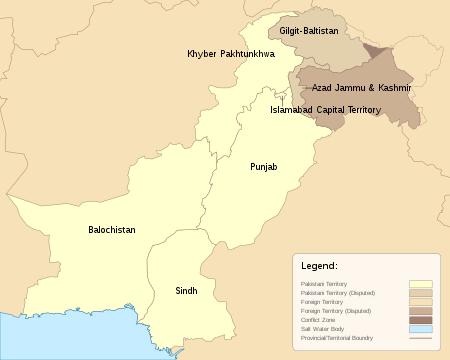
A federal parliamentary republic state, Pakistan is a federation that comprises four provinces: Punjab, Khyber-Pakhtunkhwa, Sindh, and Balochistan.[153] and four territories: theTribal belt, Gilgit–Baltistan, Islamabad Capital Territory, and Kashmir. The Government of Pakistan exercises the de facto jurisdiction over the Frontier Regions and the western parts of the Kashmir Regions, which are organised into the separate political entities Azad Kashmir and Gilgit–Baltistan (formerly Northern Areas). In 2009, the constitutional assignment (the Gilgit–Baltistan Empowerment and Self-Governance Order) awarded the Gilgit–Baltistan a semi-provincial status, giving it self-government.[154]
The local government system consists of a three-tier system of districts, tehsils and union councils, with an elected body at each tier.[155] There are about 130 districts altogether, of which Azad Kashmir has ten[156] and Gilgit–Baltistan seven.[157] The Tribal Areas comprise seven tribal agencies and six small frontier regions detached from neighbouring districts.[158]
Clickable map of the four provinces and four federal territories of Pakistan.

The law enforcement is carried out by a joint network of intelligence community with jurisdiction limited to the relevant province or territory. The National Intelligence Directoratecoordinates the information intelligence at both federal and provincial level; including the FIA, IB, Motorway Police, and paramilitary forces such as the Pakistan Rangers and theFrontier Corps.[159]
The court system is organised as a hierarchy, with the Supreme Court at the apex, below which are High Courts, Federal Shariat Courts (one in each province and one in the federal capital), District Courts (one in each district), Judicial Magistrate Courts (in every town and city), Executive Magistrate Courts and civil courts. The Penal code has limited jurisdiction in the Tribal Areas, where law is largely derived from tribal customs.[159][160]
Military
Main article: Pakistan Armed Forces


The armed forces of Pakistan are the eighth largest in the world in terms of numbers in full-time service, with about 617,000 personnel on active duty and 513,000 reservists, as of tentative estimates in 2010.[161] They came into existence after independence in 1947, and the military establishment has frequently influenced in the national politicsever since.[106] Chain of command of the military is kept under the control of the Joint Chiefs of Staff Committee; all of the branches joint works, coordination, military logistics, and joint missions are under the Joint Staff HQ.[162] The Joint Staff HQ is composed of the Air HQ, Navy HQ, and Army GHQ in the vicinity of the Rawalpindi Military District.[163]
The Chairman Joint Chiefs of Staff Committee is the highest principle staff officer in the armed forces, and the chief military adviser to the civilian government though the chairman has no authority over the three branches of armed forces.[162] The Chairman joint chiefs controls the military from the JS HQ and maintains strategic communications between the military and the civilian government.[162] As of current, the Chairman joint chiefs is General Rashid Mahmood alongside with chief of army staff General Raheel Sharif,[164] chief of naval staff Admiral Muhammad Zaka,[165] and chief of air staff Air Chief Marshal Suhail Aman.[166] The main branches are the Army–Air Force–Navy–Marines, which are supported by the number of paramilitary forces in the country.[167] Control over the strategic arsenals, deployment, employment, development, military computers andcommand and control is a responsibility vested under the National Command Authority which oversaw the work on the nuclear policy as part of the credible minimum deterrence.[90]
The United States, Turkey, and China maintain close military relations and regularly export military equipment and technology transfer to Pakistan.[168] Joint logistics and majorwar games are occasionally carried out by the militaries of China and Turkey.[167][169][170] Philosophical basis for the military draft is introduced by the Constitution in times of emergency, but it has never been imposed.[171] Since 1947, Pakistan has been involved in four conventional wars, the first war occurred in Kashmir with Pakistan gaining control of Western Kashmir, (Azad Kashmir and Gilgit–Baltistan), and India capturing Eastern Kashmir (Jammu and Kashmir). Territorial problems eventually led to another conventional war in 1965; over the issue of Bengali refugees that led to another war in 1971 which resulted in Pakistan's unconditional surrender of East Pakistan.[172] Tensions in Kargilbrought the two countries at the brink of war.[91] Since 1947, the unresolved territorial problems with Afghanistan saw border skirmishes which was kept mostly at themountainous border. In 1961, the military and intelligence community repelled the Afghan incursion in the Bajaur Agency near the Durand Line border.[173][174] Rising tensions with neighboring USSR in their involvement in Afghanistan, Pakistani intelligence community, mostly the ISI, systematically coordinated the U.S. resources to the Afghan mujahideen and foreign fighters against the Soviet Union's presence in the region. Military reports indicated that the PAF was in engagement with the Soviet Air Force, supported by the Afghan Air Force during the course of the conflict;[175] one of which belonged to Alexander Rutskoy.[175]
Apart from its own conflicts, Pakistan has been an active participant in United Nations peacekeeping missions. It played a major role in rescuing trapped American soldiers fromMogadishu, Somalia, in 1993 in Operation Gothic Serpent.[176][177][178] According to UN reports, the Pakistani military are the largest troop contributors to UN peacekeeping missions.[179]


Pakistan has deployed its military in some Arab countries, providing defence, training, and playing advisory roles.[180][181] The PAF and Navy's fighter pilots have voluntarily served in Arab nations military against Israel in Six-Day War (1967) and the Yom Kippur War (1973), of which, the Pakistan's fighter pilots shot down ten Israeli planes in the Six-Day War.[176] Requested by the Saudi monarchy in 1979, the special forces units, operatives, and commandos were rushed to assist Saudi forces in Mecca to lead the operation of the Grand Mosque.[182] In 1991 Pakistan got involved with the Gulf War and sent 5,000 troops as part of a US-led coalition, specifically for the defence of Saudi Arabia.[183]
Since 2004, the military has been engaged in a war in North-West Pakistan, mainly against the homegrown Taliban factions.[184][185] Major operations undertaken by the Army include Operation Black Thunderstorm and Operation Rah-e-Nijat.[186][187]

No comments:
Post a Comment